February 7, 2011

Super Bowl XLV


Time for the obligatory Super Bowl Cheering / Gloating.


What a great game! I can honestly say that had the Steelers won, I still would have thought it was among the great Super Bowl game.

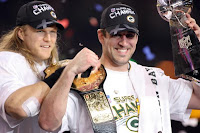
As a Packers fan though, I have to say I've never been prouder to be a fan. With the Looking Players vs. Owners dispute, I find it refreshing that the only team in the league that does not have an owner brought the Lombardi trophy home.

For me the 2010 / 11 Packers season is one of those great seasons that will live in so many fans' memories. Plagued by injury early on, and never really given the benefit of the doubt, the Packers focused thier energy through out the season and really displayed how well a team can function when the sum of it's parts is celebrated and not the individuals. I feel like I got to see a lot of great teamwork and camaraderie this year, and in the end it paid of. I particularly like that Charles Woodson is the type of man that can admit he broke-down at half time and only just reminded his team mates how much a win would mean to him and the other veterans.


It was a nervous affair for me and my hat goes off to the Steelers (except for Big Rapping Ben). They were a worthy opponent and it is always hard to watch as I sympathize what they experienced in the loss. I also particularly like Coach Tomlin.

At any rate, I also realize most of you were more interested in the commercials and half time show.

The Half time show:

I didn't mind it, but I can see why it is getting blasted for not being great. I also have to wonder how badly the Cowboys organization messed up the sound as it seemed to be more than flat at several different times.

Im a Fergie fan so I didn't mind it.


The commercials.

I'll list my favorite 3 and my least favorite 3.

Generally I feel like this was a mediocre year for commercials as a whole… Im completely sick of most of the Car commercials, and find my self mostly looking forward to movie trailers.


My favorites:

Doritos - The Best Part

I don't know why but I found this one to be the funniest… the guy they picked to be the Doritos lover just assured he has a job for several more commercials… it's wierd, innapropriate and funny.


Budweiser – Wild West


I like the idea here… the Clydsdales weren't over used and the Elton John bit at the end was really funny.


Marvel – Trailer: Capt. America


Wow. Evans doesn't look terrible in this and the CGI to make him look puny at the begining is pretty damn good. Plus they tip their hand to the Red Skull… Im officially excited for this now.


HATED!

Motorola – Empower The People


In my opinion, this is a less than clever attack on Apple's 1984 Superbowl commercial… The miss here for me is that unless your paying attention at the end, you probably think this is a commercial for Apple's iPad. That seems a little more than stupid to me… and I don't really get the idea that Mac is this overlord company that requires you to behave a certain way to experience thier products…. I guess for my two cents, it's time for these android knock offs to advertise based on what they have instead of what Apple has.


Sony – Android Is Ready To Play


It’s ugly, gritty, borders on disgusting, and then you see thumbs on a robot (reminiscent of Human Centipede) and I'm pretty much done this idiot droid.
Here we see Sony making the same mistake that Nokia made years ago… Your phone is a gaming device! It has playstation control knobs on it ! wtf???
If the idea is to beat Apple at the game app market, they need to realize Apple didn't intend for the iphone to be a gaming device… they simply provide an sdk and the users /small businesses developed the games.


Bud Light – Hack Job


A boring take off from last years Bud-House, this one is dull, silly and not even close to the standard for a Super Bowl commercial…

The Good, the Bad, and the Ugly • Part 1


Here is the first of what I hope to be many entries in The Good, The Bad, and the Ugly. Admittedly I got the idea, (far from original) from Gamestop magazine.
Herein I will offer you my take on my latest Geek experiences.

The Good: Stuff I generally enjoyed and find either engaging or particularly well conceived.

The Bad: This will usually be stuff I didn't expect to hate, games I find no love for, or tid-bits from pop culture I just can't stomach.

The Ugly: I'll take pot shots at the stuff I find literally disgusting, out of character, or just plain awful; the stuff I find myself gagging on.


For this instalment:

Red, The Other Guys, and Natalie Portman.


The Good:

Red (Retired, Extremely Dangerous) 2010

Director: Robert Schwentke (his only other film of note: The Time Traveler's Wife)

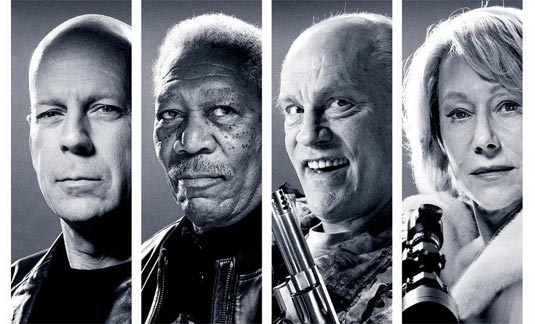
Cast: Bruce Willis, Morgan Freeman, John Malkovich, Helen Miren, Mary Louise-Parker, Brian Cox, and Karl Urban (Bones, from the latest Star Trek franchise)

Bet you didn't know this was based on a comic book of the same name by DC. I sure didn't, and overall it feels a lot like a comic, tongue-in-cheek.

Red is the story of Frank Moses (Bruce Willis), retired black ops operative and love-seeker. He pines for Sarah (Mary Louise-Parker) a clerk that handles his retirement checks.
Moses finds himself on the receiving end of a black ops hit and together with Sarah, he tracks down his old associates in order to strike back at the devious agents that would have him dead.

Viewed from the high level, and considering a movie with this type of cast, there is nothing special or Oscar worthy of Red. There in lies it's greatness. The pay off here is watching such a great cast pull off an light hearted, AARP version of The Expendables. Each supporting actor pulls in a solid performance as unwilling retirees seeking the thrills of their former lives.
Bruce Willis is right at home as the super spy action hero. Freeman does anything but phone in a short lived performance as the aging face man. Much of the well timed humor comes from /Malkovich, who, admittedly isn't straying far from his niche, but really shines in his interactions with the other actors. I'll admit to finding Helen Miren totally hot as a retired MI-6 Assassin. Parker plays a there / not there non-spy and would be generally forgettable save for her well timed doses of reality driven sarcasm.


It all boils down to a nearly campy heist / spy movie that I found thoroughly enjoyable,
even laughing out loud at several scenes. It's fast moving, energetic and well paced.

Red was my sleeper hit of the winter.


The Bad:

The Other Guys:

Director: Adam McKay (Anchorman, Step Brothers)


Cast: Will Ferrell, Mark Wahlberg, Samuel L Jackson, Dwayne "The Rock "Johnson, Eva Mendes, Rob Riggle, Michael Keaton

This is an unwatchable comedy that revolves around a pair of mismatched cops (Farrell and Wahlberg), with an atrocious storyline detailing the partners' efforts at solving a financial mystery… I think. Like McKay's other Ferrell films, it's obvious that each shooting day was little more than an improv contest between actors. The most obvious problem here is the complete and total lack of laughs from hopelessly stale material that even Will Ferrell can't escape. After 20 minutes I began to feel bad for actors I actually respect. I stared in disbelief as they tried to pull off lines that only the likes of Will Ferrell can butcher. Eva Mendes is so out of place and obviously uncomfortable with her lines that I felt embarrassed for her when I imagine that McKay intended for her to turn me on.

Ferrell's long and aggressively unfunny rant about why a lion could never successfully attack a tuna represents everything that's wrong with The Other Guys, and ultimately served as my point of no return… to bad it's in the first 20 minutes. There's subsequently never a point where the viewer is drawn into the surprisingly complicated and consistently uninvolved narrative, which cements the movie's place as a misfire of impressively epic proportions.


The Ugly:

Natalie Portman in No String Attached.

Disclaimer. I haven't seen this film… and won't see this film. What the Hell is going on? Why is such an acclaimed actress slumming around in a rom-comedy with Ashton Kutcher?

Until it is revealed that she was forced to make such a shitty movie as compensation for her role in Black Swan, Natalie Portman is on the Ugly list… and how the hell does Ashton Kutcher still have a movie career?

January 31, 2011

The Half-Hour Toy Commercial, Part 4: Thundercats, Ho!


The Thundercats were created by Tobin "Ted" Wolf, a self-made Rennaissance Man who, after losing part of a leg at the Battle of the Bulge during World War II, studied mechanical engineering and went to work for Westinghouse. Eventually, he struck out on his own as an independent inventor; he has numerous patents to his name, many of them for toy designs (like a portable record player from the '50's). That is, quite literally, about all the information I've been able to find on him. I seem to recall reading an obituary for him from 1999, I think it was in The Comic Book Buyers Guide, that stated he had been a writer for Rankin Bass, the company that produced The Thundercats, throughout the '60's and '70's, which would make sense, but that's a 12 year old memory and I haven't been able to find it confirmed anywhere. His daughter, Janice, in an article about the Thundercats' enduring popularity from a 2000 issue of The Honolulu Advertiser, remembers sitting at the dinner table with him as he designed the characters. Be that as it may, Leonard Starr, a long-time veteren of the comics and animation industries, describes being approached by Arthur Rankin and Jules Bass around 1981 about helping them develop the Thundercats project; as Starr tells the story, all they had was the name, the logo and the insignia (which he called a brilliant piece of design work), and fully rendered drawings of "a lion-man...a panther man...at least one reptile, and what would eventually become the...Thundertank." He was asked if he could make something of these various elements, and quickly (apparently, they gave him a weekend). He opted to give it a shot and so came up with pretty much everything else that we recognize as The Thundercats, premise, characters, technology and all. After he turned it in, Jules Bass apparently requested that the Thundercats' leaders name be changed from Lion-L to Lion-O (when I first saw the pilot movie as a child, I thought his name was Lion-L, which I thought was a horrible name; sounds like the name of an accountant), suggested the characters of Wilykit and Wilykat, and asked that the sorceror Mumm-Ra and his monstrous henchman be combined into one character (which is why the mummified Mumm-Ra can transform into the big nasty version). Rankin and Bass loved what Starr came up with, and offered him the position of Head Writer (which he took; he wrote the pilot and several episodes throughout the first season, including the fan-favorite Annointment Trials) and a share of the profits from merchandising, which he turned down. He asked instead for residuals (money made, on a diminishing scale, every time the show is aired) and received a good-faith promise that he would get them, but he never did. Starr later attempted to sue Rankin Bass for those residuals after the first season of Thundercats finished production, but his suit never went anywhere. Despite this, Starr is gracious and positive about Rankin Bass and his experience with the show. About the "created by Ted Wolf" byline, given just how much of the show he himself created, Starr admits to never having met Wolf and, for a long time, thinking that he didn't exist, that he was just a name invented for copyright reasons (a common corporate practice, or at least it used to be, on creative projects that are the work of many hands, especially when that work is on a for-hire basis; this was the case with all those Doc Savage and Shadow pulp stories from the '30's and '40's, as well as on the Nancy Drew and Hardy Boys mysteries). Still, as Starr himself points out, Wolf apparently recieved royalties (and his estate still does) for The Thundercats, and "nobody in this business lets go if money for nothing."

The Thundercats is what in the animation industry is described as "toyetic," which means that it's felt by its producers to be capable of supporting a line of toys. Unlike He-Man, Transformers, or GI-Joe, The Thundercats was not concieved initially as a toyline, but as an animated series that was felt could support a line of merchandise that included toys. The toys based on The Thundercats were actually a bit disappointing, clunky and rather indifferently designed, in my opinion. Their sales were not on a par with He-Man, Transformers, and GI-Joe either, which all dominated the toy market when they were released. Of the four, Thundercats is primarily remembered, by those who remember it at all, as a cartoon, while the the others are primarily remembered as toys. So there you go.


Animation for the series was provided by Pacific Animation Corporation (which was descended from Topcraft, which was in turn descended from Toei Animation; many of Topcraft's staffers, including it's founder Toru Hara, would go on to join Studio Ghibli and work on Hayao Miyazaki's many masterworks). There's a family resemblance in just about all of Rankin Bass's traditional animated works, with the obvious variations you'd get for tone; The Thundercats is no exception. The anime roots of its designers worn proudly on its sleeve, The Thundercats bears more than a passing resemblance, in terms of visual style, to the Rankin Bass films The Hobbit, The Return of the King, The Last Unicorn, and The Flight of Dragons. It's markedly less fanciful or romantic than those works, which likely accounts for the more pronounced differences (it's visual style is identical, however, to The Silverhawks, which perhaps isn't surprising, given that both series were produced by Rankin Bass around the same time; The Silverhawks bears all manner of resemblance to Thundercats, in animation, tone, style, and construction). The animation is a considerable cut above the norm for an '80's animated series, though occasionally off model and frequently a bit stiff.; it has the Japanese standard for frame-rate movement, which is slower than the American standard, and which generally makes for more detailed drawings but can also make the animation considerably less dynamic (think of the average fight scene in your standard anime--it's usually a few very brief seconds of action broken up by several minutes of verbal posturing, reflection, and internal dialogue). The opening animation, however, is a joy and a wonder to behold, brimming with power and energy, with some truly complex shots; it's still held up today as a high water mark for action animation.


The Thundercats series begins as the inhabitants of Thundera, cat-like humanoids of various descriptions, leave their planet in search of a new home (Thundera explodes a few minutes in to the first episode; no official explanation is ever given as to why until I believe the 4th season, where it's destruction is attributed to the Sword of Plun-Darr). "Thundercat" is a term applied to Thunderian nobility, and the command ship of the "Thunderfleet" contains the heads of the chief noble houses of Thundera: Jaga, Tygra, Cheetara, Panthro, and the twins Wilykat and Wilykit, as well as Lion-O, the heriditary Lord of the Thundercats and his "nanny" Snarf (we are given to understand much later in the series that his given name is Osbert, and "snarf" is the name of his species). The fleet is attacked by the Mutants of Plun-Darr (Panthro's line of "Always those blasted Mutants!" would seem to indicate a history of some animosity), who succeed in damaging the command ship and destroying most of the fleet (by the fourth season, which I've only read about and never seen, it is apparently revealed that most of the fleet was simply scattered). Because of the damages to their ship, the Thundercats are forced to alter their course from their original destination to one "Third Earth," a journey which will still take them decades. The Thundercats make the journey in suspension capsules which slow their aging, all but Jaga who elects to guide the ship (Jaga, already the oldest of the Thundercats, dies of old age shortly before they arrive on Third Earth, but appears regularly to Lion-O as a spirit guide). Upon landing, it is discovered that Lion-O has inexplicably grown to manhood while the others have remained unchanged, and the Thundercats set out to make their way on Third Earth. Opposing them are the Mutants, who have followed them (who also apparently have suspension capsules, because they haven't aged either), and Mumm-Ra, an ancient force for evil native to Third Earth who senses the arrival of the Eye of Thundera, a powerful mystical relic embedded in the hilt of Lion-O's Sword of Omens, which he feels will threaten his power (we are given to understand that the Mutants have historically been after the Eye as well, which is the reason for their generational wars with the Thunderians and their pursuit of the command ship). Thus is the series established and thus does adventure ensue. Much of the first season is given over to the Thundercats carving out their own space on Third Earth, building their home (the Cat's Lair) and salvaging equipment, making allies, and searching for fuel (Thundrillium, they call it, which fortunately can be found on Third Earth), and fighting off attacks by the Mutants and Mumm-Ra, who form an uneasy alliance (uneasy of the part of the Mutants; Mumm-Ra seems fine with it).


I must point out at the beginning that I loved this series as a kid, and have a great deal of affection for it still. From a fan-geek perspective, there are a lot of elements that are just hinted at but never explored ( for instance, during the annointment trials, it is alluded to briefly that each of the Thundercats represents a clan, the "Tygra Clan," the "Panthro Clan," etc.). We are never given much backstory on the individual Thundercats; indeed, most of the time the focus is squarely on Lion-O with the others coming in to support him. I understand the narrative purposes of this, particularly given the way catoons were done in the '80's, but still, as a fan it's a bit maddening. What's more, as I'm sure you've gleaned from the above, there's a lot in that initial premise that seems labored or nonsensical. The bit with Lion-O aging while none of the others do has been grist for the fan-fiction mill for years; Jaga mentions in the pilot that the suspension capsules only slow the aging process, not stop it, and Tygra later states that Lion has physically aged about 12 years. If from that you assume that all the Thundercats have physically aged 12 years, well and good, but then how to explain Wilykat and Wilykit still being children? The official line was that their particular type of Thundercat didn't get any bigger; again, fine, but then why do the others treat Lion-O like an adult, and the Wily-twins like kids? Maddening, no? What? Move on to something else? Fine then. Be that way.


Mumm-Ra was an excellent villian, actually quite frightening, and the thuggish-yet-cunning Mutants were a good complement to him. Many of the mystical entities that Mumm-Ra summoned to take on the Thundercats were well done as well; I remember particularly a fear-spirit named Mongor who was an anthropomorphic goat with a firey scythe who got bigger the more his opponents were afraid of him looked down right satanic and disturbing. Future seasons would introduce new villains (like the Lunataks from the Moons of Plun-Darr, one of which, Luna, was a tiny woman who rode around on the back of a big, bull-like fellow called Amok, and for some reason just creeped me out to no end), and new allies as well.
The Thundercats ran in first-run syndication from 1985 to 1990, for a virtually unheard-of total of 130 episodes (all available on DVD from Warner Bros, though they confusingly label season 2, 3, and 4 as season 2, parts 1 and 2). As far as I can remember, seasons 3 and 4 were never broadcast in my area, so I've got me some cartoons to watch!


Some great news for fans of The Thundercats that Warner Bros. animation is producing a new series to air on Cartoon Network in the fall of 2011. It's animation is provided by Japanese Studio 4 C, which was also responsible for portions of the Animatrix and Batman: Gotham Knight. It's executive producer is Sam Register (who produced Teen Titans, Ben10, Batman:The Brave and the Bold, GI-Joe: Resolute, and pretty much everything Warner Bros. animation does for Cartoon Network), with Michael Jelenic ( writer for Wonder Woman and Batman: The Brave and the Bold) and Ethan Spaulding ( a director and artist on Avatar: The Last Airbender). Very little information has been given out in regards to the series except to say that they've streamlined things (I get the impression that the Thundercats and the Mutants are now supposed to be warring factions from the same planet) and retooled certain factors that the series makes more sense (Lion-O looks to be in his late teens in the production art that has been released, which provides all the same dramatic possibilites as making him a "boy in a man's body" without being, you know, goofy). The tone is described as being darker, and more attention is being payed to each character's individual backstory. According to Spaulding, the biggest changes are to Tygra, who the current writers felt lacked punch in the original version (I thought he was cool and Zen, but he was pretty underused, particularly after the first season). Promo art shows Tygra armed with a pistol as well as his traditional bolo-whip and, while Spaulding won't say what Tygra's new "added dimension" is, I have certain suspicions. Larry Kenny, the original voice of Lion-O, is returning as the voice of Claud-Us, who was Lion-O's father in the original series but whom Kenny describes as Lion-O and Tygra's father. Now, this kind of slip makes the geek in me speculate. Hmm...So Tygra and Lion-O are brothers...but Tygra, who is apparently older than Lion-O, is not in line for the throne...is he Claud-Us's illegitimate son? Historically, it wasn't at all uncommon for a king or lord to acknowlede his illegitimate offspring and give them an honored place at his court. Again, I'd be very surprised if this turns out to be the case, given that this show isn't slated to air on Adult Swim, but given the evidence, it seems a natural assumption. It would be cool to see Tygra as the Jon Snow to Lion-O's Rob Stark (that's a reference to George R.R. Martin's A Song of Ice and Fire series, for those of you who don't know).

In closing, let me say this about the "Half-Hour Toy Commercial," particularly to those who would denigrate it. Give kids some credit. If kids like a toy already, and if the toy lends itself to such, they will probably appreciate it if a cartoon is made around that toy. More ways to enjoy the thing, you know? Similarly, if kids enjoy a cartoon, they'd likely enjoy it if toys were made to support it, for similar reasons. Kids like cartoons, kids like toys. There you go. If a toy is lame, a cartoon, even if it's great, can't save it; a lame toy might get a temporary boost in sales from a great cartoon, but that boost isn't likely to last. As I've said, there are loads of lame toys and equally lame cartoons made to help market them that have been, justly, forgotten. Quality will win out, in the end. Most people's arguments against the "Half-Hour Toy Commercial" seem to come down to some idea that it's somehow immoral to market things to kids, which in turn comes down to the odd notion that it's wrong to show kids cool stuff, because that will make kids want stuff. Seems a weak argument to me. As to the accusation that these cartoons have limited value because they're so "commercial," I can only say this; what is and isn't "art" is decided by future generations, and human memory is fleeting and idiosyncratic. A cartoon should be produced because someone wants to produce it, because it's felt to be fun and entertaining, and/or because it's felt someone, somewhere, might enjoy it.


And there you have it!

January 24, 2011

Half-Hour Toy Commercials, part 3: A Real American Hero!


GI Joe, as most know, began as a 12'' posable action figure (it was for the GI Joe line of toys that the term "action figure" was coined, conventional wisdom being that boys would not play with dolls) made by Hasbro in 1964, with different models made to represent the four branches of the US armed forces. In 1982 Hasbro sought to rebrand the franchise, using smaller figurines that utilized the Microman technology they had bought from Japanese toymaker Takara, and so contracted with the Griffen-Bacall advertising agency to concoct a marketing strategy. Prior to this, comics pro Larry Hama had pitched an idea to the editors at Marvel Comics called "Fury Force," in which the son of Nick Fury (of Howling Commandos and S.H.E.I.L.D. fame,) leads a team of military specialists against the Neo-Nazi depradations of Hydra. Marvel passed on the idea, but when Griffen-Bacall enlisted Marvel to partner with them on the development of GI Joe, Hama, a Vietnam combat veteren and expert in all things military, was tapped to create characters and scenarios and thus did Fury Force become GI Joe; all of the characters in the first wave of GI Joe toys were to have been members of Fury Force, with Fury Jr. replaced by Hawk as leader of the team (I would personally have loved to've seen Dum Dum Dugan as a GI Joe). Hama himself wrote the character file cards included with each figure (and would continue to do so for the next decade) as well as nearly every issue of Marvel's 155-issue GI Joe comic (to which I had a subscription!). Let me say that it was an excellent comic, a natural decendent of the great war comics of the 50's and 60's, and issue 21, "Silent Interlude," in which Snake-Eyes rescues Scarlet from a Cobra stronghold, is considered by many to be a modern classic in that it is completely silent, with no dialogue or sound effects, demonstrating the comic book's power as a visual story-telling device (it also introduced Storm-Shadow and gave us the first hints about the mysterious Snake-Eyes past, which was just too cool!).


To advertise the GI Joe toys (and the comic as well, the first time I'd ever seen a comic book advertised on TV), Griffen-Bacall had their in-house animation studio Sunbow partner with Marvel Productions (formerly De Patie-Freleng, who, aside from creating the Pink Panther, had animated a number of Marvel properties already, like the Fantastic Four) to create a number of fully animated commercials (with character designs by the likes of Gerry Chiniquy, a veteren Warner Bros. animator, and the great Russ Heath, a legendary cartoonist known for war and western comics--and whose work was extensively ripped off by pop-artist Roy Lichtenstein). These commercials proved so popular that Hasbro decided to produce an animated GI Joe mini-series, and so GI Joe: A Real American Hero (also known as GI Joe: The Mass Device) was born, in 1983. It was followed by GI Joe: The Revenge of Cobra in 1984, and GI Joe: the Pyramid of Darkness in 1985, which led directly into the reguar series.


Animation was provided by Marvel/Sunbow, and the mini-series was written, as were all the GI Joe mini series and the series bible (based on Larry Hama's notes), by veteren tv writer Ron Friedman (whose credits stretch back to Gilligan's Island and Get Smart, and who would also write both the GI Joe and Transformers animated movies). Friedman has stated he handled the large cast involved in GI Joe by thinking of both the Joes and the Cobras as large families and the individuals as various family archetypes; each side would have a "Big Daddy" and "Mother" figure (Duke and Scarlett, or later Flint and Lady Jaye --Friedman said he treated both pairs of characters as interchangeable--for the Joes, and Destro and the Baroness for the Cobras), a "Weird Uncle" (Shipwreck for the Joes, Dr.Mindbender for the Cobras) and various sibling-style relationships (he characterized Cobra Commander as "the Spoiled Brat") among the other characters. There are, as one might expect, numerous differences between the comic and cartoon iterations. For example, in the cartoon Duke is present from the beginning and is shown clearly to be the Joes' field commander, whereas in the comic Duke did not appear until issue 22; Larry Hama has stated that he had always considered Stalker to be the Joes' "first shirt," the non-comm under the officer Hawk (whose original design Duke bears quite a resemblance to, much to many fans' confusion) but for its own reasons, Hasbro wanted Duke to serve as the Joes first seargent, so he bowed to their wishes. Shipwreck plays a much larger role in the cartoon than he does in the comics, while the fan-favorite Snake-Eyes, while he does have some excellent moments (particularly in The Mass Device) and is usually present in group shots or group actions, has a much diminished role, likely due to the writers' uncertainty in handling a mute character. Cobra Commander is himself played much more for humor in the cartoon, with his ego, his temper and his posturing, whereas in the comic he is much more competant and dangerous.


Cobra is itself probably one of the best concieved villianous organizations in comics OR cartoons. For a series aimed at grade-school children, they're a very realistically portrayed terrorist organization; in the comics, they had their own island which was a sovereign nation recognized by the UN and had clandestinely taken over several American towns (of which Springfield is perhaps the best known; it appeared in "There's No Place Like Springfield," a two-part episode of the cartoon that I'll discuss below). They had numerous corporate fronts, a belief system and group philosophy, and even ambassadors; in the comic, they were most analagous to Nazi Germany, while the cartoon portrayed them more as a slightly more-sophisticated-than-average super-villianous organization. Interestingly, Cobra was entirely Larry Hama's idea; Hasbro had made no provision for providing the Joes with an enemy (which seems silly from both narrative an marketing standpoints). He did an excellent job concocting a dangerous and believeable foe.


The cartoon was itself occasionally corny but also frequently dramatic. In The Mass Device, te first mini-series, there's a sequence where a captured Duke and Snake-Eyes are made to fight each other for Cobra Commander's amusement. Later, we're treated to Snake-Eyes wandering alone in the arctic, doing his damnedest to protect a radioactive component necessary to the titular device, the very image of stoic perseverence. The series took the time to develop emotional beats as well, things you usually didn't see in kids' adventure cartoons. In "World's Without End" a small team of Joes is transported to an alternate reality where Cobra has conquered the world. One of the Joes, Steeler, is bitten by a genetically engineered insect that makes him sick and delirious; his fevered reactions to this alternate world in which he and all his comrade have been defeated and killed is intense and genuinely heart-breaking (at least it was to me, when I was 10). In "There's No Place Like Springfield," Shipwreck and Lady Jaye are sent to an island to retrieve Professor Mulaney, a scientist who has developed a formula to turn water into a bomb. When they find him, he implants the formula in Shipwreck's brain, which can only be accessed with a codeword he gives to Lady Jaye. Shipwreck is knocked unconscious while tryinh to escape a Cobra assault on the island and wakes up six years later with a wife and daughter in Springfield, a town to which all the Joes retired after their final defeat of Cobra. This episode was my second experience with the "36 Hours" plotline, wherein a character with important information is placed in a controlled "safe" reality where his information is irrelevant in the hopes he will remember and reveal all he knows (my first, which I actually didn't remember until I saw this episode, was from an episode of Battle of the Planets). Shipwreck's anguish and anger when he discovers that Springfield is just a lie are quite effecting, and adds a tragic edge to his otherwise fairly goofy character.


GI Joe: A Real American Hero ran for 98 episodes in first run syndication, from 1985-87. It was capped off by GI Joe: The Movie (in which Duke, in the original script, was supposed to die; as it stands, he got better) in 1987. In 1989, DIC Entertainment produced a 44 episode series that utilized the characters and scenarios from the original series, but lacked much of the "magic." Other series include GI Joe: Extreme in 1996 from Gunther-Wahl productions (no connection to the original; I never saw this one, so I can't comment), and the anime-styled GI Joe: Sigma 6 (which utilized many of the central characters -- Duke, Snake-Eyes, Scarlet-but otherwise didn't have much to do with the original; still, not bad overall) in 2005. In 2009, to tie in with the live-action film GI Joe: The Rise of Cobra, Warner Bros. Animation produced GI Joe: Resolute as an 11-part animated web series (broadcast in it's entirety on Cartoon Network's Adult Swim in April of 2009). It was written by comics scribe Warren Ellis and directed by Joaquin (Avatar: The Last Airbender) Dos Santos. This is as close to an update of the original series as anyone is likely to get, and it is quite good; it's a great deal of fun hearing a barking mad Cobra Commander cussing out his subordinates. Currently a new series, GI Joe: Renegades, which has been described as "GI Joe meets the A-Team," airs on The Hub network.

All in all, a good series. Fun, engaging, and cleverly written, especially given the no doubt tight restrictions they were under, given the essentially violent nature of the show. Good Times!


Next time: Thundercats!

December 28, 2010

The Half-Hour Toy Commercial, Part 2: More Than Meets the Eye!


The story behind the Transformers begins with with a pair of toylines from Japanese toymaker Takara (also known as Tomy in the US) known as Microman and Diaclone. In 1974 some of the Microman line was licensed by Mego (known to geeks like me for their wide collection of DC and Marvel Super-Hero doll...uh...8-inch action figures) and was marketed as The Micronauts. The Micronauts toyline failed (though the Marvel Comic based on it is quite fondly remembered by many and, like Rom: Spaceknight, outlasted the toy on which it was based) but the technology behind the line was bought by Hasbro who then used it to rebrand it's GI Joe line from the '60's as GI Joe: A Real American Hero. As anyone who was a little boy (or was buying toys for one) in the early '80's knows quite well, GI Joe was a giant success. So much so that Hasbro elected to buy the rights to Takara's Diaclone line as well; Diaclone was a spin-off of Microman, featuring exceptionally tiny Microman figures piloting transformable mecha (designed by future Macross -- known by many in the US as Robotech -- designers Shoji Kawamori and Kazutaka Miyatake). Hasbro decided to follow the same formula that had brought them success with GI Joe; partnering with Marvel Productions and the Griffen-Bacal Advertising agency (which also brought their own animation studio --Sunbow--into the mix) they used a three-pronged marketing strategy which included the toyline, a Marvel comic-book tie-in, and an animated series. Marvel's then-editor in chief, Jim Shooter, developed the basic plot outline--warring robot factions, good Autobots waging their battle to des-troy the e-vil forces of....the Decepticons--and then brought in comics great Dennis O'Neil to create character names and profiles. For whatever reason, Hasbro was unsatisfied with the bulk of what O'Neil turned in and asked for revisions, which O'Neil declined to do (he is, however, credited with having named Optimus Prime). Shooter then brought in Bud Budiansky, who would go on to write the Transformers comic for Marvel, who then proceeded to hammer out the characters and scenarios most of us remember.


The animated series was produced jointly by Marvel Productions and Sunbow Productions, with the bulk of the animation done by Toei (in Japan) and Akom (in Korea). It debuted in America in syndication in September of 1984, with the three-part pilot "More Than Meets the Eye." This was immediately followed by the series. Oh, and in case you're wondering as to why I'm covering Transformers before GI Joe, it's because, while Marvel/Sunbow produced two syndicated GI Joe mini series ("GI Joe: A Real American Hero" --also called "The MASS Device,"-- and "The Revenge of Cobra") in 1983 and '84, the series itself didn't start until 1985, a year after the debut of Transformers. You probably weren't wondering. Oh well...


Suffice to say, Transformers was a big success, not only in the US, but also in Great Britain and Japan. This actually makes discussing the series a little difficult, as, after the US series ended in 1987, Japanese animators Toei produced 5 more Japan-only Transformers series (using the same character designs and plot threads from the original series), and Great Britain had at least one season cobbled together from old animation. What's more, the Transformers has been resurrected a number of times, as Transformers:Beast Wars, Transformers: Armada, and the more recent Transformers: Animated (ick, in my opinion), just to name a few, right up to the most recent version appearing exclusively on The Hub. For the purposes of this article, I will only be discussing what has come to be called Transformers, Generation 1, the series that aired in the US from 1984-87.


This one loomed large in my childhood. The toys were a pure delight; the first one I got was given to me by my dad (not even on my birthday! How about that?) and was one of the smaller plastic Transformers that I now understand were from the Diaclone line (the most famous of these was, of course, Bumblebee, though that wasn't the one I was given). Later I got the Lamborghini, Sunstreak, and was just about as pleased as a nine-year old could be. The cartoon was just icing on the cake; it was on in the early morning, just before I went to school, so I got to watch it while eating breakfast. Let's make no bones about it, it was an adventure series aimed at elementary-school kids, but even so, it had echoes of the epic in it, particularly in the later seasons. The animation was the kind anyone familiar with a Marvel/Sunbow production would expect; occasionally quite good, sometimes a bit sketchy but, somehow, always compelling (Marvel/Sunbow , together or apart, also produced Spider-Man and His Amazing Friends, The Hulk, GI Joe, Dungeons and Dragons, and a host of others, just in case you didn't know, and, in the case of Marvel Productions, was the last remnant of the old Termite Terrace that produced all those great Warner Bros. cartoons). There's a definite anime flavor to the animation that's subtle, but easy to catch if you know what to look for. But, as with anything, the appeal was not so much the animation as the characters, and the mythos.


The basic storyline as established for the cartoon was that the Autobots and Decpeticons had for centuries (or perhaps millennia) been fighting for control of their home planet, Cybertron. When energy reserves begin to run low, the Autobots launch a mission, led by their commander Optimus Prime, to search for new resources. Optimus and his crew are pursued by the villianous Megatron and a contingent of Decepticons. Both ships crash-land on a prehistoric Earth and are, for reasons I can't remember, placed in some form of suspension until they awake in our modern era. They take the forms of various vehicles and machines in order to camoflage themselves, and so their conflict continues, with humanity and the Earth now thrown into the mix.


The heart and soul of The Transformers was Optimus Prime, leader of the heroic Autobots. He was pretty much everything any little boy (and probably not a few little girls) might hope to grow up to be: powerful, compassionate, just, intelligent and heroic. And he was a giant robot; I mean, c'mon, who didn't want to be a giant robot? At least once? The characters that surrounded him, except in the VERY beginning, tended to fluctuate; at first you had Ironhide and Doc and Jazz and so forth, but the writers would occasionally haul somebody else in if they could use them to a specific purpose. Bumblebee was always a constant; he was the perenniel "little brother" to the other Autobots, a young soldier, spy and scout with loads of courage and potenetial but little comparative experience (which is funny, since according to the series even the youngest of the Autobots is several million years old). On the opposite side you had the sneering, brutal Megatron and his lieutenants, the ambitious Starscream and the coldly obedient Soundwave. An interesting twist in this series was that the heroes always seemed to be playing catch-up to the villians; the Decepticons controlled Cybertron, where the Autobot resistance had been driven underground, and controlled the "cosmic elevator" (or whatever) that allowed them to get supplies from home. The Autobots allied themselves with humanity, but that ended up doing us more good than it did them. The essential difference between Autobots and Decepticons was not so much that one was good and the other evil as that the Autobots worked to preserve life and sustain themselves while the Decepticons only concern was to sustain themselves and to secure their means of doing so. As time went on we learned more about the history of Cybertron, about how both Autobots and Decpticons had been slaves to the Quintessons (and their respective emblems were slave brands--the Autobots as workers and the Decepticons as soldiers).Ultimately the Decepticons would be driven from Earth, but the Autobots would lose Cybertron to them in the process. Optimus would die and be resurrected; the horrendous Unicron, Devourer of Worlds would show up (he was, I'm not kidding, a truly titanic robot that transformed into a planet--after his destruction in Transformers: The Movie there was a whole storyline where one of the Decepticons was hearing voices telling him to reattach Unicron's head to Cybertron so that Unicron might be reborn...crazy stuff).


The Transformers ran in first-run syndication from 1984 to 1987, for a total of 98 episodes. Transformers:The Movie (the animated one, not the one with Shia LaBoeuf) came out in '86, and is well worth taking a look at (and yes, that's Orson Welles as Unicron, believe it or not). A fine adventure 'toon, all things considered. A good deal of fun.


Next time: GI Joe!

December 7, 2010

The Half-Hour Toy Commercial, Part 1: In the Beginning...

Okay, because YOU demanded it (well, maybe not): Toy-Based Cartoons: Crap, or Completely Worthless Drek?


Just kidding, folks. This particular post is inspired mostly by irritation; I was tooling around on Cartoon Brew, a site devoted to all things animated, and in one talkback thread a number of commentators were talking smack about the phenomenon of the "half-hour toy commercial," i.e., the animated cartoon based on a toy. If you're like me, some of your fondest cartoon memories stem from such fare, so you can understand if I felt a little miffed by the prevailing attitude. So, I did a little research on the subject and voila, this post is what you get. Don't you feel lucky?


First off, a history lesson. You'd think the "half-hour toy commercial" has existed as long as there's been TV animation, right? Not so. In the mid-sixties, Mattel attempted to produce an animated series based on Hot Wheels, their venerable miniature toy car line. They received the smackdown in no short order from the FCC, who then issued a ruling that said, essentially, that no cartoon (or children's program) was to be based on a toyline, (or existing product, aimed at children) for all the reasons that you might imagine (I haven't been able to discover if this Hot Wheels series was ever actually aired, or if it died in the production stage). Cartoon characters could be used to advertise products, and were (the Flintstones were used to sell cigarettes, Jonny Quest to sell sneakers, etc), but no cartoon could be completely based around a saleable product. This did not cover, for reasons that I've not seen made clear but am grateful for, cartoons based on comic books, or cartoons that themsleves inspired toylines. This ruling held until approximately 1980, when it was significantly amended; the FCC's new policy stated that a cartoon COULD be based on a toy, so long as that toy was not otherwise advertised during the cartoon's commercial slots. This ruling was by no means unchallenged but the floodgates, so to speak, were opened.


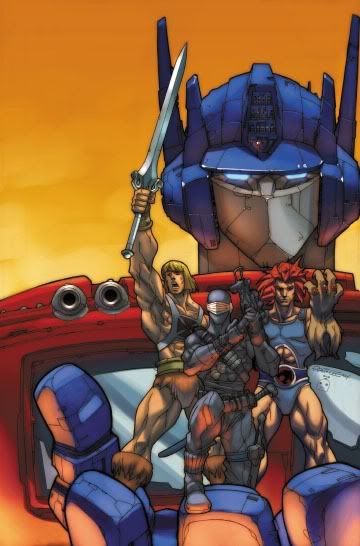
At this point you might be asking "So Rob, what was the first cartoon to be based on a toy?" Well, here's where it gets a little hazy. There are cartoons based on product lines that include toys, but are not inspired by toys specifically; there are cartoons that are not based on toys, but clearly hope to inspire them (this coined the term "toyetic" among cartoon producers, to refer to elements of a show that could help to support a toyline, such as special vehicles and whatnot; Thundercats is perhaps the best example of this), and various permutations along those lines. The first cartoon to be based on a licensed product line was American Greeting Card's Strawberry Shortcake. This line began in 1977 and had multiple iterations in the form of cards, toys, games, etc. The cartoon series began in 1980 and as such, technically qualifies as the first "half-hour animated commercial" for anything. Then you have Pac-Man, based on the legendary video game, which premiered in 1982 (and was considered such a hot property at the time that its commercial breaks were double the normal length to accommodate all its advertisers). If you asked most people who care anything about the topic, they'd say the first was probably Filmation's He-Man and the Masters of the Universe, given that it was first a toyline and then a cartoon. Be that as it may, I'm not going to attempt to be exhaustive in my discussion here; there are simply too many series to discuss with any breadth and, to be honest, a lot of them really are pure crap (Rubik the Amazing Cube? Gwenevere and the Jewel Riders? Meh.) In most cases, few even remember the really bad ones, or the equally lame toylines they were based on. I, instead, am going to focus on series I feel were particularly good, particularly important, or ones that, for ephemeral reasons, I just plain liked. It's my post, so I'll talk about what I want. Nnyah!


He-Man and the Masters of the Universe:

-based on the popular sword and sorcery toyline from Mattel. Mattel had originally intended to base a line of toys on Conan the Barbarian, given the resurgence on interest in the character brought about by Marvel Comics’ adaptation and the (then) recent Arnold Schwartzenegger film. Somewhere in production, however, either out of a failure to secure merchandising rights or someone getting the idea that a marauding Nietzschean barbarian probably wasn’t the best model for a line of children’s toys, they came up with Masters of the Universe instead. The backstory they came up with, as detailed in the mini-comics that were included with each figure (beautifully illustrated by Conan veteran Alfredo Alcala) was very reminiscent of Conan’s world, with some science fiction elements thrown in by way of Eternia’s being a post-apocalyptic wasteland with advanced weapons and vehicles as well as magic thrown into the mix. The toys were a big success, so Mattel commissioned Filmation, then a leader in adventure cartoons, to come up with an animated series. Filmation dumped the original premise for the one most of us are familiar with, in which Adam, the prince of Eternia (now more like Flash Gordon’s Mongo –-Flash Gordon, perhaps not coincidentally, being another animated series produced by Filmation—than Conan’s Hyboran age), presented with a magic sword by the mysterious Sorceress of Greyskull which can transform him into He-Man, the “Most Powerful Man in the Universe,” defender of all that is good and true and so forth. His nemesis, the evil Skeletor, plots with his henchmen to conquer Eternia, and also to control the mysterious Castle Greyskull and thus gain, one imagines, absolute power. The premise combines elements of a traditional super-hero scenario with the afore-mentioned Flash Gordon, and bears a more than passing thematic resemblance to another Filmation series, Blackstar, which preceded it by about a year.

I freely admit that I enjoyed He-Man quite a lot when it originally aired in syndication. It was exciting and, as I’ve mentioned in other posts, adventure cartoons have always been something of a rarity. Filmation actually did a lot of great work on this series; the character designs are excellent (and the female characters actually hot, which was a bit of a novelty in 1983, when this series premiered), the backgrounds are detailed and appropriately surreal, and the music is actually quite effective in setting tone and mood. Still, even at the time, I thought the show’s reliance on stock animation was a bit hokey (a lot of character action sequences, clearly rotoscoped, were used repeatedly; this is kind of a hallmark of Filmation productions). Believe it or not, even with the cost-cutting measures of re-used animation and a limited voice cast, He-Man was one of the costliest productions of the ‘80’s because it was entirely produced in the U.S., by union animators, rather than relying on overseas studios. For the time, many of the scripts were groundbreaking, dealing with actual character issues (Adam’s feelings that he can only be of use to anyone through He-Man, Teela’s discovery that she’s an adopted child, Orko’s feeling’s of uselessness, etc.). Looking at it now though, it seems so extraordinarily dated as to make me cringe, especially with the hit-you-over-the head morals tacked on at the end of each episode. He-Man actually pioneered that particular format, one echoed in most toy-based adventure 'toons throughout the ‘80’s. Even though I remember this series fondly, I can’t say it’s one I’d care to see again, even through the rosy spectacles of nostalgia.

He-Man ran in first-run syndication from 1983 to 1985 for a whopping 130 episodes, and it’s spin-off series She-Ra, Princess of Power (1985-87, and introduced in the film The Secret of The Sword, which I am only slightly embarrassed to admit I paid money to see) ran for 77; both episode counts are quite impressive, especially when you consider that a good run for an animated series today is 65 episodes. He-Man was reworked into the almost unrecognizable The New Adventures of He-Man, from French/Canadian animation company DIC, in 1990, and was revived in 2002 as a series, for Cartoon Network, from Mike Young Productions, which more or less faithfully followed the characters and scenarios laid out in the original 'toon.


A few things I didn't know about He-Man, that I learned while doing research for this article: J.Michael Strczynski (creator of Babylon 5) and Paul Dini (one of animation's top writers and one of the guiding lights behind Batman: The Animated Series) were both writers for He-Man, and Bruce Timm (also of Batman: TAS and currently one of the heads of the DC Universe animation wing of WB Animation) was an animator on it; Timm's first published comics work was one of the mini-comics included with a He-Man action figure.
Well, that’s all for now. Join us next time for The Half-Hour Toy Commercial , Part 2: The Transformers!